
why contorting yourself for shiny opportunities backfires
szn jobs ep 1 w/ nicole lee: shoot your shot, with aim
Tube top is talking careers for the next couple months, and for our first issue in the series, we have a piece that was originally published in Nicole Lee’s Substack am i... a marketer?
The piece, The foot-in-the-door fallacy, is about the temptation to chase well-known company logos even if it comes at the cost of finding a good fit role (relatable!) — and how to moderate it. But its wisdom applies to more than just a prestige job search, if we can be so lucky. Nicole’s advice on knowing yourself, making little leaps, and building credibility is helpful for oh, say, folks who are multi-hyphenate to a fault too. We definitely don’t know any of those types…
If you love it as much as we did, give Nicole’s Substack a subscribe! Nicole is a marketer, writer, community builder, and fellow girl based in San Francisco. Follow her on LinkedIn / X/Twitter, and attend one of her Luma Events if you’re in SF!

The foot-in-the-door fallacy
A strategy that eats itself
There’s a particular kind of career advice that circulates like a benign virus: “Just get your foot in the door.” Get in anywhere. Any role. The company logo on your LinkedIn (or getting your visa sponsored for some of us moving to different countries) matters more than the work itself. You can pivot later. You can course-correct once you’re inside.
It’s advice that sounds pragmatic, even wise… until you actually take it.
I’ve been thinking about this a lot lately, particularly after reading a LinkedIn post that crystallized something I’ve watched play out dozens of times. The post was direct: don’t take a role you don’t actually want just because you love the company. Don’t use “foot in the door” as a strategy. It costs more than you think.
And god, is that true.
The performance tax
Here’s what nobody tells you about the foot-in-the-door strategy: you’re not just performing during the interview. You’re signing up to perform indefinitely.
These companies become objects of desire, and desire makes us stupid. We contort ourselves to fit. We pitch a version of ourselves that’s adjacent enough to be believable but fundamentally misaligned with what energizes us.
You find yourself explaining why your content marketing background totally translates to product ops, or why your growth experience means you’d be great at customer success. Maybe you even convince them. But here’s the thing: you also convince yourself. And that’s where the trouble starts.
Because now you’re in. You got the offer. You’re working at the dream company. Except you’re spending 40+ hours a week doing work that doesn’t light you up, proving competence in a domain you’re not genuinely excited about, and wondering why you feel flat.
I’ve felt flat, and it’s not a great feeling. You lose your fire, your spark.
The performance tax compounds. You’re not building momentum in your actual area of strength or working towards where you actually want to be. You’re building a reputation for something you’re lukewarm about. And when internal opportunities open up, the ones you actually want, you’re typecast. You’re “the customer success person” when you wanted to be in product marketing. You’re “the ops person” when you wanted to be in growth.
The “adjacent” trap
There’s a subtle distinction here that matters: this isn’t about never stretching. Stretch roles are real and valuable. The question is: are you stretching into something that’s a natural extension of your strengths, or are you contorting yourself into something fundamentally misaligned?
Every role you take sets context for what you’re “good at” and where you “belong.” When you take a role that’s not in your lane just to access a logo, you’re positioning yourself poorly. You’re creating context that works against your actual goals.
And undoing that positioning later? Exponentially harder than just waiting for the right opportunity in the first place.
One of the comments on that post nailed it: companies want to hire for what you’ve done, not what you might be able to do. They’re making a bet, and they want a sure thing. When you apply for a role outside your lane, you’re asking them to make a riskier bet.
And you’re doing it from a position of weakness. Desperation dressed up as flexibility.
The cultish pull of company brands or working in a different city
Tech companies, especially those with strong brands, build powerful emotional bonds. There’s an in-group. There’s a shared vocabulary. There’s a sense that being inside matters more than what you’re actually doing inside.
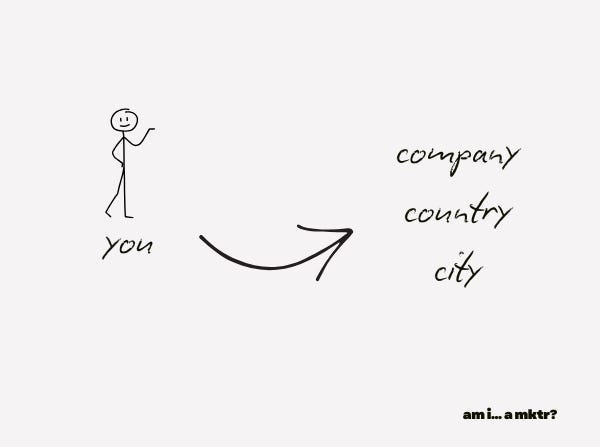
Cities and countries do the same. Many of my friends in San Francisco and New York want to swap places all the time for different reasons. The grass is always greener on the other side, some might say.
This is why people bend their narratives to fit open roles at dream companies and cities. It’s not really about the job. It’s about belonging. It’s about being able to say you work there. It’s about proximity to something that feels important.
But belonging without alignment is a particular kind of loneliness. You’re in the building, but you’re not doing the work that makes you feel alive. You’re at the parties, but you’re playing a character. And the longer you perform, the harder it gets to remember what your actual strengths are.
Companies are still sort of important, though
Here’s the thing everyone forgets when they’re lusting after a company logo: this is a two-way bet. You’re taking a bet too.
Yes, the company is betting on you. But you’re also betting on them. And your bet might actually matter more.
You’re betting that their product has traction. That they’ve figured out something real about their market. That they’re not just burning through runway on a thesis that hasn’t been validated. You’re betting that the marketing org (or product, or growth, or whatever function you’re joining) is well-run. That there’s actual infrastructure. That you’ll have mentorship. That you’ll learn systems and frameworks you can take with you.
Because here’s what matters most in any job: what you learn.
Not the logo on your LinkedIn. Not the free lunch or the equity package or the ping pong table. What you learn. The mental models you build. The reps you get. The patterns you start to recognize. The taste you develop for what good looks like.
And you don’t learn that stuff in a poorly-run org, even if it’s at a prestigious company.
I’ve seen people take roles at big, recognizable companies only to end up in dysfunctional teams with no clear strategy, no experienced leaders to learn from, and no real product-market fit to work against. They spent a year or two treading water, polishing a brand that looked good on the outside but offered nothing to actually build on.
Meanwhile, other people joined less sexy companies with strong orgs, places where the VP of Marketing had actually scaled a function before, where there were real systems for experimentation, where product-market fit was strong enough that you could actually see what moved the needle and what didn’t.
Guess which group learned more?
The company matters. But not because of its brand. Because of what it can teach you. That’s the point many miss.
Whether the product has enough traction, your work can create a real impact.
Whether the org is structured well enough that you’ll develop judgment, not just survive chaos.
Shoot with aim
“Shoot your shot with aim” is maybe the most useful reframe I’ve heard in a while.
It’s not about lowering your ambition. It’s about directing it precisely. It’s about knowing the difference between a stretch and a mismatch. It’s about understanding that the right opportunity should feel like momentum, not method acting.
Here’s what aim looks like in practice:
Know your lane. Not just what you’re capable of doing, but what genuinely energizes you. What work makes time disappear? What problems do you think about in the shower? Where do your natural curiosities live? Your lane isn’t necessarily your current job title. It’s the throughline in your best work.
I recently turned down a content marketing role and have actively avoided recruitment calls for content alone to improve my personal positioning for product marketing! I didn’t want to go back in that direction.
Look for direct adjacency. If you want to pivot, find an entry point that’s one step removed from where you are, not five.
For example, if you’re in content and want to move into product marketing, look for roles where storytelling, educating, and positioning intersect. Don’t jump to other positions just because it’s at the same company. Ensure there are transferable skills.
Show proof outside the job. If you’re serious about a pivot, build credibility before you need it. Write. Ship side projects. Take courses. Build a body of work that demonstrates genuine commitment, not just opportunistic interest when a role opens up.
For example, I took courses with the PMA and also got a product marketing coach before asking my manager to put me on that track while I was a content marketer. I started creating repositioning, messaging, battlecards, one-pagers, and more, and kept track of these product marketing examples to advance in that direction.
Choose soil over stage. The metaphor from the original post is perfect: the right team should feel like soil that supports growth, not a stage where you’re performing. Soil is patient. Soil is nourishing. Soil doesn’t require pretense. If you’re auditioning for a role, you’re probably in the wrong place.
The long game
The foot-in-the-door strategy is a short-term optimization that sabotages long-term growth. It’s the career equivalent of growth hacking without a product people actually want. You might get traction, but it’s not sustainable.
The alternative isn’t to wait passively for perfect opportunities. It’s to be fiercely selective about where you spend your energy. To recognize that every role you take teaches the market (and yourself) something about what you’re for.
This requires patience. It requires discipline. It requires tolerating the discomfort of saying no to things that look good on paper but feel wrong in your gut.
But here’s what it gives you: clarity. Momentum. A career that’s actually yours, built on work that energizes you, in rooms where you belong not because you performed your way in, but because your strengths and curiosities naturally align with what the work demands.
The right company will still be there when the right role opens up. And when it does, you won’t have to stretch your examples or perform a version of yourself. You’ll just show up as exactly who you are—and that will be enough.
Start with the lane. Then pick the track.
The logos can wait.